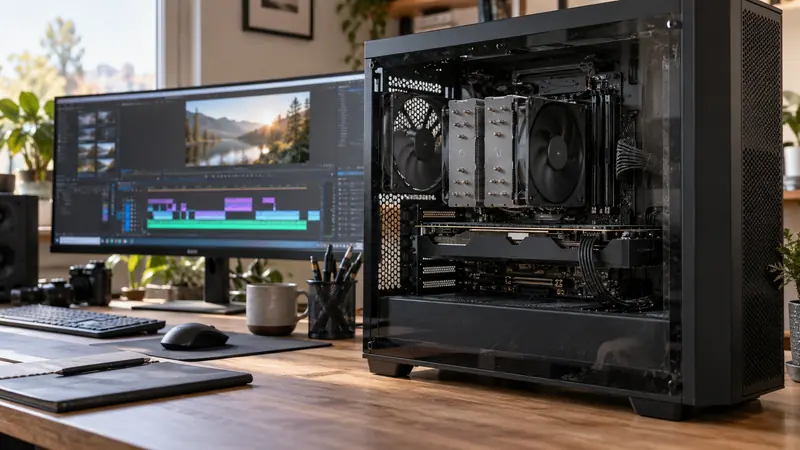
Answer: Measure an appropriate sample and scale elapsed time by duration only as a planning model. Check difficult sections separately and label the variation as an assumption.
On this page
Creator Edit Lab editorial project · Updated October 21, 2026 · Original decision framework and illustrative example. No physical product measurement or hands-on benchmark is claimed.
Why the distinction matters
A timeline can contain easy cuts, heavy denoising, motion graphics and cached regions. A sample drawn only from an easy opening can understate the full task. Fixed setup and finalization time also mean a very short sample may not scale cleanly. Record the exact range, cache state and settings before timing it.
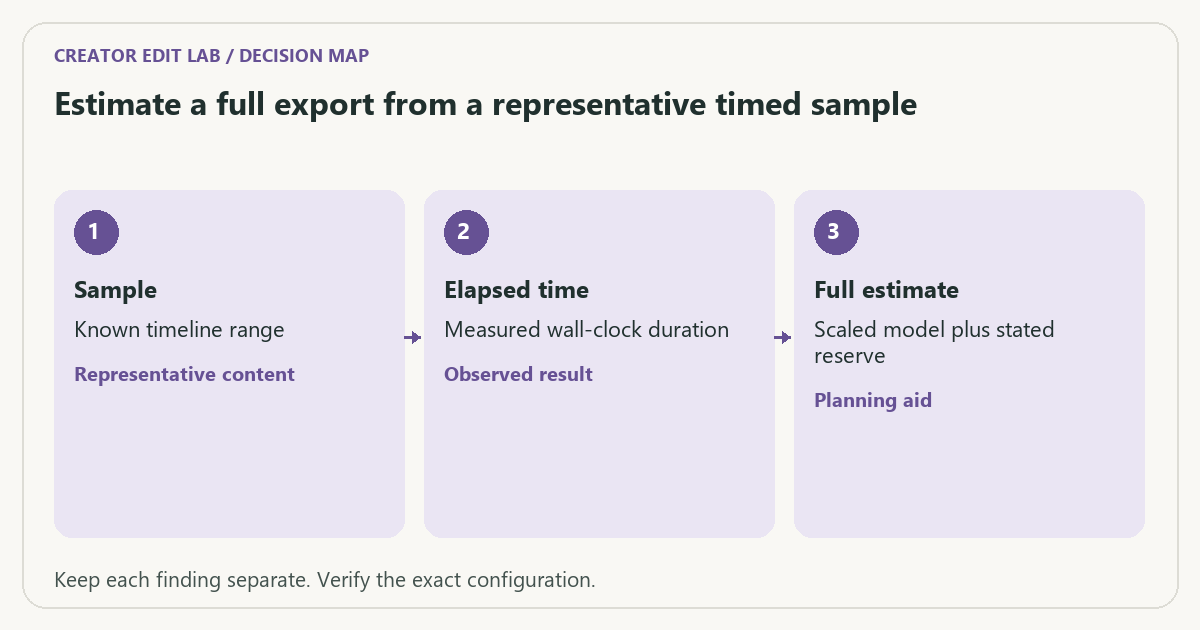
A practical sequence
- Select a sample that represents the project’s typical work and identify any heavier region.
- Record sample duration and elapsed export time under the intended settings.
- Calculate a duration-scaled estimate and state excluded fixed work or uncertainty.
- Compare with another representative sample or the finished run when available.
Decision record
| Check | What it means | What to verify |
|---|---|---|
| Sample | Known timeline range | Representative content |
| Elapsed time | Measured wall-clock duration | Observed result |
| Full estimate | Scaled model plus stated reserve | Planning aid |
Worked example
An illustrative 30-second sample takes 45 seconds, a ratio of 1.5 seconds of work per second of program. A 10-minute timeline would scale to 900 seconds, or 15 minutes, before fixed work and content differences. A heavy effects section can invalidate that simple extrapolation.
Verify the result
Keep the machine and application state documented. User-chosen low and high ranges are not statistical confidence intervals. Before a deadline, allow time for verification and a corrected export as well as the render itself.
Download the editable CSV worksheet · Delivery workbook
Question and answer
Can I estimate from the first ten seconds of any project? Only as a weak sample if it is representative. Choose content that includes the actual limiting work and note fixed overhead.
Sources and scope
- Adobe Premiere: export settings reference — Export, caption and source options; verify your installed release.
The decision sequence, diagrams, worksheet and worked case are our editorial work. AI assisted research, drafting and implementation. Official references support the named technical distinctions; examples do not establish real product performance.
Continue the task
- Why video export takes longer than the timeline
- Archive an editing project with a readable delivery manifest
- Browse the complete resource library
Build on what you just learned
Your next useful step.
Test a representative section before spending.
Resolve Free or Studio? Buy for a demonstrated workflow need
I would start with Resolve Free when its tested workflow meets the project, and buy Studio for a specific supported feature or processing requirement.
Read the guide →
USB-C is a connector: check the data speed of the whole SSD path
I would check the host port, cable, hub and SSD specifications before paying for a faster external drive.
Read the guide →