Start with a task, then follow the details. Browse the visual library, choose a topic or search for a problem. Every guide links to a useful next step and a tool where it helps.
Follow your curiosity
Find your next useful answer.
96 guides to explore

Upgrade to Resolve 21 with a project-copy acceptance test
I would upgrade a working editing system only after preserving a recoverable project library and testing a representative project copy.
Read the guide →
Resolve 21 Photo page: test a still-and-video workflow before moving the archive
I would try Resolve 21’s Photo page on a small mixed-media project before replacing an established photo workflow.
Read the guide →
Resolve 21 subframe audio edits: solve the click without moving the picture
Use fine audio timing when a frame-sized move is too coarse for a click, fade or transient.
Read the guide →
Generative Extend: a few extra frames still need an editorial review
I would use generated extensions for a deliberate transition or timing need, then inspect the new frames and identify them in the project record.
Read the guide →
Premiere transcription: choose the language and proof names before making captions
I would transcribe a short representative passage before generating captions for the entire edit.
Read the guide →
Resolve Free or Studio? Buy for a demonstrated workflow need
I would start with Resolve Free when its tested workflow meets the project, and buy Studio for a specific supported feature or processing requirement.
Read the guide →
OBS Hybrid MP4 or MKV? Choose for recovery and the editor you use
I would choose a recording container that tolerates an interrupted write, then test it in the actual editor.
Read the guide →
DaVinci Resolve proxy media vs optimized media vs render cache
Use source alternatives when decoding the camera files is the problem; use render caching when repeated timeline processing is the problem. Proxy media, optimized…
Read the guide →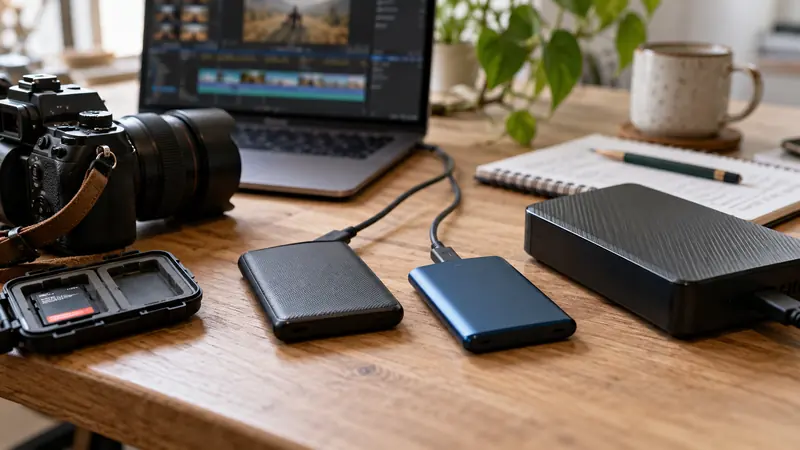
Resolve 21 IntelliSearch: budget the analysis before relying on search
I would test IntelliSearch on a representative media subset and keep a conventional folder and logging system alongside it.
Read the guide →
An HDR capture card still needs a complete SDR delivery test
If the deliverable is SDR, I would plan and verify the HDR-to-SDR conversion rather than trusting a capture card’s HDR badge.
Read the guide →OBS recorded the microphone, but the player is silent: inspect the tracks
Check which audio tracks were recorded and which one the player or editor is using before rerecording.
Read the guide →Record a software tutorial so the text survives the final video size
Design the desktop layout for the final viewing size before recording a long tutorial.
Read the guide →Check a subtitle export before the client finds a broken cue
Run mechanical checks on the exported subtitle file, then watch it with the delivered video.
Read the guide →OBS overload: separate scene rendering from video encoding
I would inspect which stage is falling behind before changing the encoder or buying hardware.
Read the guide →V30, V60 or V90? Buy recording cards for the camera mode, not the logo alone
I would follow the camera maker’s approved card requirements for the exact recording mode, then use the speed class to understand the sustained-write…
Read the guide →Premiere Pro proxies: create, attach and verify originals at export
Proxies are working copies for editing. Keep the originals, confirm that each proxy attaches to the correct source clip, and verify the final export…
Read the guide →
Premiere Object Mask: check the version before handing off the project
I would include the exact Premiere build and mask mode in a project handoff, plus a short rendered reference.
Read the guide →
Stabilisation needs a crop budget before the final reframing
I would stabilise a representative shot before approving a tight crop or placing captions near the edge.
Read the guide →Clean dialogue without making the room pump between words
I would begin with a clean recording and restrained processing, then compare at matched listening level.
Read the guide →Optical-flow slow motion: inspect the invented frames, not only the smoothness
I would use interpolation when its motion improvement survives a close review of difficult frames.
Read the guide →Subtitle reading speed: use characters per second as a review prompt
Calculate reading speed to find cues that deserve attention, then judge them with the image and speech.
Read the guide →USB-C is a connector: check the data speed of the whole SSD path
I would check the host port, cable, hub and SSD specifications before paying for a faster external drive.
Read the guide →A phone clip looks portrait but reports landscape dimensions: check rotation
Compare the stored pixel dimensions, rotation interpretation and final rendered orientation before cropping a phone clip.
Read the guide →Check that a proxy matches its original before editing
Verify duration, frame rate, audio layout and visible content for a representative proxy-original pair. A low-resolution file with a matching name is not enough.
Read the guide →Before screen recording, remove the information that should never enter the edit
I would record from a prepared workspace containing only the material needed for the demonstration.
Read the guide →Input LUT or creative look? Give each colour operation one clear job
I would establish the source’s correct interpretation before applying a creative look.
Read the guide →Separate recorder audio drifts: measure the end before moving every cut
Synchronise a clear event near the start and compare another near the end before editing a long recording.
Read the guide →YouTube upload finished, but HD is missing: check processing before re-exporting
I would distinguish upload completion from higher-resolution processing before changing a good source export.
Read the guide →Subtitles start in sync but drift later: do not apply only a constant shift
Compare sync near the beginning, middle and end before shifting the whole subtitle file.
Read the guide →Samsung T7 Shield for editing: a sensible 10 Gbit/s shortlist, with limits
I would shortlist the T7 Shield for a portable editing or transfer drive when a tested 10 Gbit/s connection meets the workload.
Read the guide →Stretched faces? Check pixel aspect ratio before changing the crop
I would verify source interpretation when circles become ovals or people look stretched.
Read the guide →Verify a media copy with a hash before clearing the recording card
I would verify important copies against the source and keep independent copies before clearing a recording card.
Read the guide →A transparent export has a dark halo: check alpha interpretation first
I would compare straight and premultiplied alpha interpretation against the way the asset was exported before adding a colour correction.
Read the guide →YouTube Audio Library: keep the licence and attribution with the track
I would choose music from a documented source and keep its licence information with the project when it is downloaded.
Read the guide →Budget the upload and processing after the render finishes
I would schedule a video delivery from the completed render through transfer, platform processing and final review.
Read the guide →Translated subtitles: check meaning before polishing the line breaks
I would have a competent reviewer compare the translation with the source meaning before treating it as a finished caption track.
Read the guide →A laptop export benchmark needs a power-state record
I would benchmark an editing laptop in the power state in which it will actually be used, then repeat under a controlled alternative if…
Read the guide →Interlaced footage: check field order and motion before deinterlacing
I would identify whether the source is genuinely interlaced and verify field order before choosing a conversion.
Read the guide →
Hand off an editable title with a font manifest, not an unlicensed font folder
I would list the exact font family, style, source and version alongside a reference render.
Read the guide →Pan and zoom a still photo: budget the crop in pixels before rendering
I would plan the tightest crop at the delivery resolution before animating a photograph.
Read the guide →Deliver audio stems that line up and recombine as intended
I would agree what each stem contains and whether the stems are expected to reconstruct the approved mix.
Read the guide →Export fails at the same frame: isolate the cause
When an export repeatedly fails near the same timeline position, isolate that area in a duplicate project. Change one part of the media or…
Read the guide →Captions need speaker and sound information when the meaning depends on it
Include relevant non-speech audio and speaker identification when a viewer needs that information to understand the scene.
Read the guide →GPU memory full: isolate the effect and frame size before buying a card
I would reproduce the failure on a short project copy and identify which combination of resolution, effects and media triggers it.
Read the guide →A review file should seek reliably, not merely play from the beginning
I would test jumping to several positions in a long review export before sending it to collaborators.
Read the guide →Make review feedback point to the same frame on every system
Use an agreed reference export with visible version identity and a clear time-reference convention.
Read the guide →Washed-out exports: a color-management checklist
Compare the same exported file in a controlled viewing path before changing the grade. A different-looking player does not by itself prove that the…
Read the guide →LUFS, true peak and dialogue delivery
Measure program loudness and true peak separately. Use the delivery specification or a clearly stated house target; do not assume that a popular LUFS…
Read the guide →YouTube export settings for SDR video
For an ordinary SDR upload, start from YouTube’s published MP4 and H.264 guidance, keep the recording’s frame rate, and use the matching SDR bitrate…
Read the guide →SRT to WebVTT and back: conversion can lose more than the punctuation
Choose the format required by the destination and verify the converted file in its player.
Read the guide →Why video export is slow: isolate decode, effects, encode and write
Diagnose slow video export one stage at a time and estimate mixed timelines from representative samples, including upload and verification time.
Read the guide →An image sequence has the wrong duration: check numbering and import rate
I would verify the frame range, missing numbers and interpretation rate before stretching an imported image sequence.
Read the guide →Moving an edit between applications
Treat an interchange file as a translation of supported edit information, not as a guaranteed clone of the native project. Keep the original project,…
Read the guide →Verify a transparent video export over a contrasting background
Choose a format and workflow that support alpha, then reimport the saved file over a visible contrasting background. A black player window cannot establish…
Read the guide →Peak vs loudness normalization: calculate gain and peak headroom
Compare peak normalization with integrated loudness targets, calculate available true-peak headroom and verify the delivered audio instead of trusting a preset.
Read the guide →Video bitrate and file size: the calculation behind the estimate
For a known average bitrate, file payload size is bitrate multiplied by duration, divided by eight. Include audio in the total and distinguish decimal…
Read the guide →Two caption layers on the final video? Check burn-in and player settings
Identify whether captions are embedded in the picture, supplied as a selectable track or generated by the platform.
Read the guide →Decode, effects and encode: three different GPU questions
Ask separately whether the system accelerates source decoding, timeline processing and output encoding. These are different stages. A GPU-supported delivery encoder cannot by itself…
Read the guide →Audio sync drift: separate offsets, variable frame rate and clock mismatch
Diagnose constant audio offsets, progressive drift and sudden jumps, with a three-point sync log and a duration-preserving conversion check.
Read the guide →Backup and recovery for an editing project
Back up the irreplaceable media and the information needed to reconstruct the edit. Then test a restore. An application’s automatic project saves can be…
Read the guide →Plan an HDR-to-SDR delivery as an explicit color conversion
Identify the source and intended output color spaces, use a deliberate supported transform and inspect the saved file in the destination path. Changing a…
Read the guide →Calculate PCM audio storage with channels, sample rate and bit depth
For uncompressed PCM, multiply sample rate, bit depth, channel count and duration, then divide by eight for bytes. Keep compressed audio estimates separate.
Read the guide →Premiere vs Final Cut: a platform and workflow decision
If you need to edit on Windows, Final Cut Pro for Mac cannot be the desktop editor in that workflow. If everyone works on…
Read the guide →Subtitle fonts: test the characters and wrapping the audience will see
I would proof representative characters and long lines in the destination player before approving a caption font.
Read the guide →Hardware vs software encoding: make a controlled comparison
Compare hardware and software encoding on a representative sample with the same delivery requirements. A faster export is useful only if its picture, audio…
Read the guide →ProRes vs H.264: choose an intermediate, proxy or delivery file
Choose ProRes or H.264 by the next workflow step, compare actual sample storage and avoid treating a larger transcode as recovered quality.
Read the guide →A project folder structure that survives handoff
Separate irreplaceable originals and project data from generated working media and exported deliveries. Use stable names, document the root path and keep an inventory.…
Read the guide →Distinguish dual mono, stereo and a missing dialogue channel
Inspect channel content and the recipient’s required routing. Two channels can contain a stereo scene, two independent microphones or one useful signal plus silence.
Read the guide →DaVinci Resolve vs Premiere: choose by workflow
Choose the editor that completes your real delivery chain with the fewest fragile handoffs. Resolve deserves a close look when you want editing and…
Read the guide →Vertical video delivery for TikTok and Instagram
Build the vertical edit for the frame people will actually see, then verify it in the destination app. A 1080 × 1920 canvas is…
Read the guide →Media cache in Premiere: what is safe to clear and how to check
Identify Premiere media cache, clear it through documented controls, protect originals and distinguish cache cleanup from proxies and project backups.
Read the guide →AV1 in an editing workflow: check support before recording
Before recording an important project in AV1, take a short file through import, playback, editing and export on the actual system. Successful playback in…
Read the guide →SSD and HDD roles in a creator workflow
Choose storage by the workload and its role. An active editing drive needs dependable access to the streams you play together; a backup drive…
Read the guide →Check loudness gain against the true-peak limit before rendering
Estimate the gain needed for the requested loudness, then check whether that gain would exceed the allowed peak. Render and measure the result because…
Read the guide →Inspect an exported video with ffprobe: a delivery acceptance check
Generate a local ffprobe JSON report, compare stream properties with a delivery brief and verify the saved video with a reproducible acceptance checklist.
Read the guide →Check vertical-video captions against the actual viewing layout
Keep essential text inside a deliberate safe region and verify it in the intended platform’s current viewing layout. One permanent pixel margin cannot represent…
Read the guide →Video editing on a low-end PC: diagnose playback bottlenecks
Start with a plain timeline containing your real footage. If it already stutters before effects are added, investigate decoding and storage first. If playback…
Read the guide →H.264 vs H.265: editing cost and delivery compatibility
Choose the codec the whole workflow can handle, at an acceptable quality and file size. A smaller recording is not automatically easier to edit,…
Read the guide →Plan recording storage from actual bitrates
Calculate from the total average recording rate, recording duration and number of streams. Then budget complete copies and reserve capacity separately. The size of…
Read the guide →Avoid unnecessary lossy audio generations in a video delivery
Keep a suitable high-quality source or master and create the required compressed delivery from it. Repeatedly exporting an already compressed delivery introduces another encoding…
Read the guide →Budget video bitrate for a hard file-size limit
Allocate the total size budget across duration, audio and a stated reserve before choosing video bitrate. Then measure the actual exported bytes, especially when…
Read the guide →Choose burnt-in or sidecar captions for the recipient
Ask whether the recipient needs permanent visible text, a separate caption file or supported embedded captions. Verify the chosen route in the actual playback…
Read the guide →Identify cache before deleting files to free editing space
Classify files by whether they can be regenerated from retained sources. Use the application’s documented cache controls and preserve originals, project files and irreplaceable…
Read the guide →Why a VBR export can miss your expected file size
A target rate is an encoding instruction rather than a guaranteed final byte count. Inspect the exported average, audio and duration before changing codec…
Read the guide →Relink missing video media without choosing the wrong clip
Preserve the project, locate the intended originals and verify more than the filename. Duration, recording identity, timecode and a visible content check help avoid…
Read the guide →Find wrong export ranges and unintended black frames
Compare the intended timeline range with the saved file’s duration and endpoints. A successful export can still contain a short range, an extra tail…
Read the guide →Budget editing space for originals, cache, proxies and outputs
List concurrent working copies and generated artifacts, then reserve space for the largest expected output and temporary work. Source-media size alone understates many editing…
Read the guide →Calculate duration at fractional frame rates without rounding away drift
Use the actual rational frame rate when converting frames and duration. A rate commonly labeled 23.976 is not exactly 24, and a display label…
Read the guide →Test an editing backup by restoring a small project copy
Restore to a separate location and verify the project, source references and a short output. A backup job’s success message does not prove the…
Read the guide →Compare hardware and software encoders with the same delivery constraint
Keep the source, range, codec profile, output dimensions and delivery constraint comparable. Measure time and inspect the actual result rather than ranking encoders by…
Read the guide →Conform or convert frame rate? Decide whether duration should change
Decide whether to preserve elapsed duration or reinterpret the same frames at a new rate. Those operations can produce different speed, frame count and…
Read the guide →Name review exports so feedback reaches the right edit
Use a stable project ID and a distinct readable version for each review artifact. Keep feedback tied to that exact file and timeline basis.
Read the guide →Estimate a full export from a representative timed sample
Measure an appropriate sample and scale elapsed time by duration only as a planning model. Check difficult sections separately and label the variation as…
Read the guide →Record bit depth and chroma when checking codec compatibility
A codec name is only part of a compatibility record. Include bit depth, chroma subsampling, dimensions, frame rate, container and the actual application/hardware path.
Read the guide →Plan multicamera recording capacity and playback rate separately
Add simultaneous camera rates for throughput, and multiply each rate by its recording duration for capacity. Spare terabytes do not establish enough sustained read…
Read the guide →Archive an editing project with a readable delivery manifest
Preserve the required project, sources and approved deliverables with a manifest that explains dependencies and recovery status. A folder full of exports is not…
Read the guide →No matching guide. Try fewer words or choose another topic.
Turn an answer into your own plan
Open the Delivery workbook to keep your configuration and observations together. Individual practical guides include their own source links, decision diagrams and downloadable worksheets. The filters work locally in your browser; the full list remains available without JavaScript.