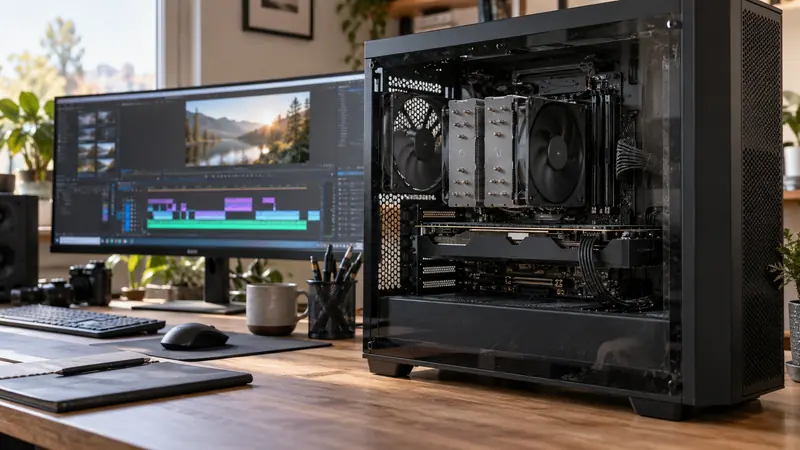
Answer: List concurrent working copies and generated artifacts, then reserve space for the largest expected output and temporary work. Source-media size alone understates many editing projects.
On this page
Creator Edit Lab editorial project · Updated October 21, 2026 · Original decision framework and illustrative example. No physical product measurement or hands-on benchmark is claimed.
Why the distinction matters
During a project, originals, proxies, caches, review movies and final exports can coexist. Some operations need temporary files before an old output is replaced. Keep each category visible and avoid claiming one universal free-space percentage. The useful reserve depends on the task and application. Backups on another device are additional capacity, not free space inside the working volume.
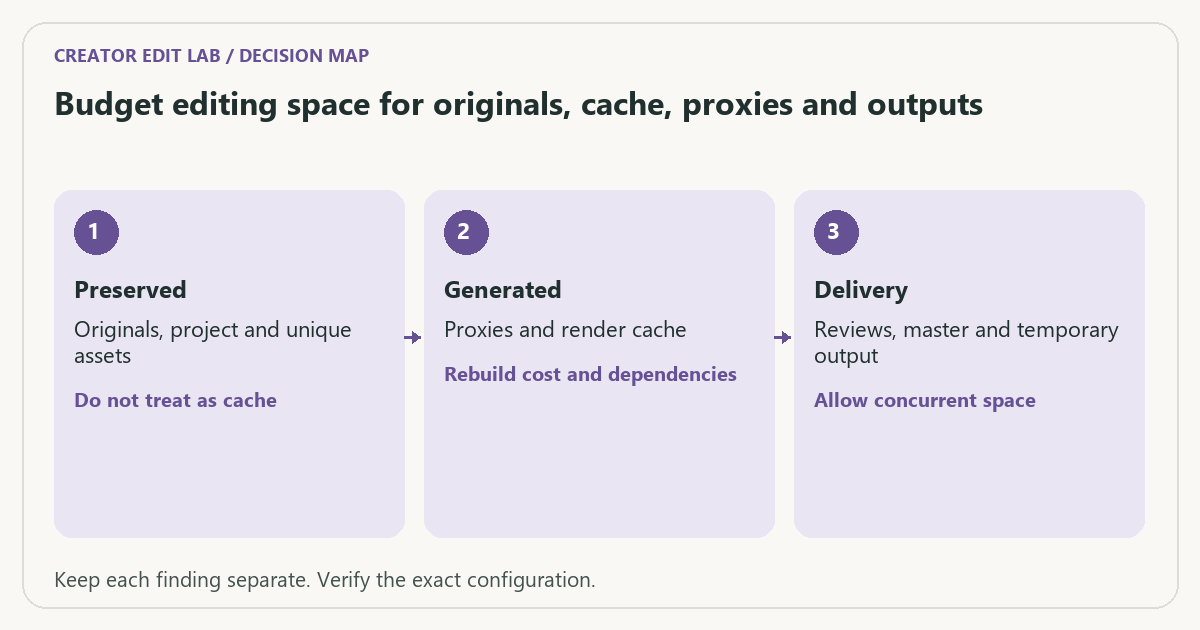
A practical sequence
- Measure current originals and other irreplaceable source assets.
- Estimate or measure proxy, cache and output needs separately.
- Identify which artifacts must coexist during the largest planned operation.
- Check actual free space before that operation and use supported cleanup only for rebuildable data.
Decision record
| Check | What it means | What to verify |
|---|---|---|
| Preserved | Originals, project and unique assets | Do not treat as cache |
| Generated | Proxies and render cache | Rebuild cost and dependencies |
| Delivery | Reviews, master and temporary output | Allow concurrent space |
Worked example
Invented categories total 300 GB originals, 60 GB proxies, 100 GB cache and 40 GB outputs: 500 GB before the chosen reserve. Adding another 40 GB final output while retaining the previous one needs additional space. A 500 GB headline drive capacity also differs from usable formatted free space.
Verify the result
Record actual sizes after the first project phase and revise the model. Keep drive health, speed and backup reliability as separate questions; a space budget cannot establish them.
Download the editable CSV worksheet · Delivery workbook
Question and answer
Can I delete old outputs before making the next one? Keep the approved or recoverable version until the replacement is verified, unless you have a deliberate recovery plan.
Sources and scope
- Blackmagic Design: support and manuals — Locate the manual matching your Resolve release and edition.
The decision sequence, diagrams, worksheet and worked case are our editorial work. AI assisted research, drafting and implementation. Official references support the named technical distinctions; examples do not establish real product performance.
Continue the task
- SSD and HDD roles in a creator workflow
- Calculate duration at fractional frame rates without rounding away drift
- Browse the complete resource library
Build on what you just learned
Your next useful step.
Test a representative section before spending.
Resolve Free or Studio? Buy for a demonstrated workflow need
I would start with Resolve Free when its tested workflow meets the project, and buy Studio for a specific supported feature or processing requirement.
Read the guide →
USB-C is a connector: check the data speed of the whole SSD path
I would check the host port, cable, hub and SSD specifications before paying for a faster external drive.
Read the guide →