Answer: Add simultaneous camera rates for throughput, and multiply each rate by its recording duration for capacity. Spare terabytes do not establish enough sustained read or write performance.
On this page
Creator Edit Lab editorial project · Updated October 21, 2026 · Original decision framework and illustrative example. No physical product measurement or hands-on benchmark is claimed.
Why the distinction matters
A multicamera project can involve several streams at once, while a sequential archive copy reads one set differently. Compressed bitrate is useful for a first model but does not capture every decoding or filesystem constraint. Separate recording, editing and backup tasks. Use measured rates from the actual profiles when available and keep a practical reserve explicit.
A practical sequence
- List each camera’s actual recording profile, bitrate and planned duration.
- Calculate total recorded bytes, including separate audio and stated reserve.
- Add the rates of streams that must be accessed simultaneously.
- Test the real recording or multicamera playback task on the intended system before relying on the plan.
Decision record
| Check | What it means | What to verify |
|---|---|---|
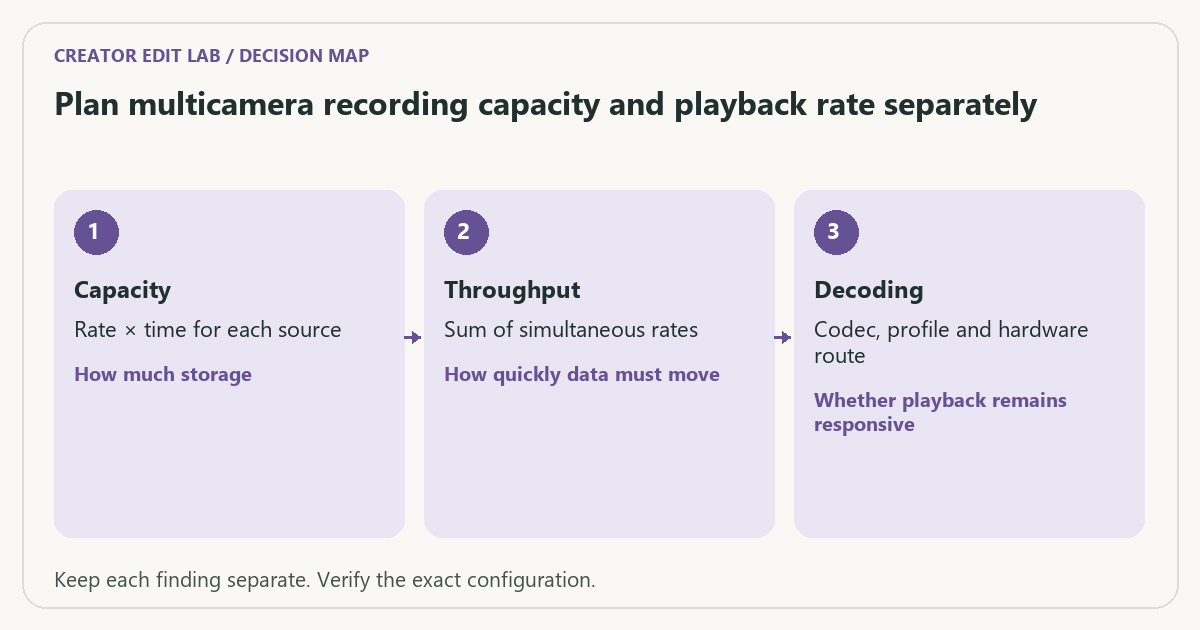
| Capacity | Rate × time for each source | How much storage |
| Throughput | Sum of simultaneous rates | How quickly data must move |
| Decoding | Codec, profile and hardware route | Whether playback remains responsive |
Worked example
Four hypothetical cameras at 100 Mbps each require 400 Mbps, or 50 MB/s, of compressed video data when read simultaneously. Each hour produces about 45 GB per camera, or 180 GB total before audio, overhead and reserve. Those numbers do not certify a drive’s sustained behavior or the editor’s decoding speed.
Verify the result
Keep source profiles and measured trial conditions with the result. Account for shared-bus activity and backup copies separately. Do not use an interface’s advertised maximum as a measured end-to-end rate.
Download the editable CSV worksheet · Delivery workbook
Question and answer
Does enough disk capacity prove smooth multicam playback? No. Throughput, decoding, effects and other system work remain separate constraints.
Sources and scope
- FFmpeg: ffprobe documentation — Read-only stream and format inspection. A metadata report does not prove visual quality.
The decision sequence, diagrams, worksheet and worked case are our editorial work. AI assisted research, drafting and implementation. Official references support the named technical distinctions; examples do not establish real product performance.
Continue the task
- Plan recording storage from actual bitrates
- Budget editing space for originals, cache, proxies and outputs
- Browse the complete resource library
Build on what you just learned
Your next useful step.
Organize, relink and restore with confidence.
Upgrade to Resolve 21 with a project-copy acceptance test
I would upgrade a working editing system only after preserving a recoverable project library and testing a representative project copy.
Read the guide →
Resolve 21 IntelliSearch: budget the analysis before relying on search
I would test IntelliSearch on a representative media subset and keep a conventional folder and logging system alongside it.
Read the guide →